Measuring Brand in the Interpretation Era
How to measure brand and reputation in the age of AI: know what the world sees, what to do about it, and whether it's working.
by Beth Crain, founder of Spotted Pony PR · Measurement
Key Points
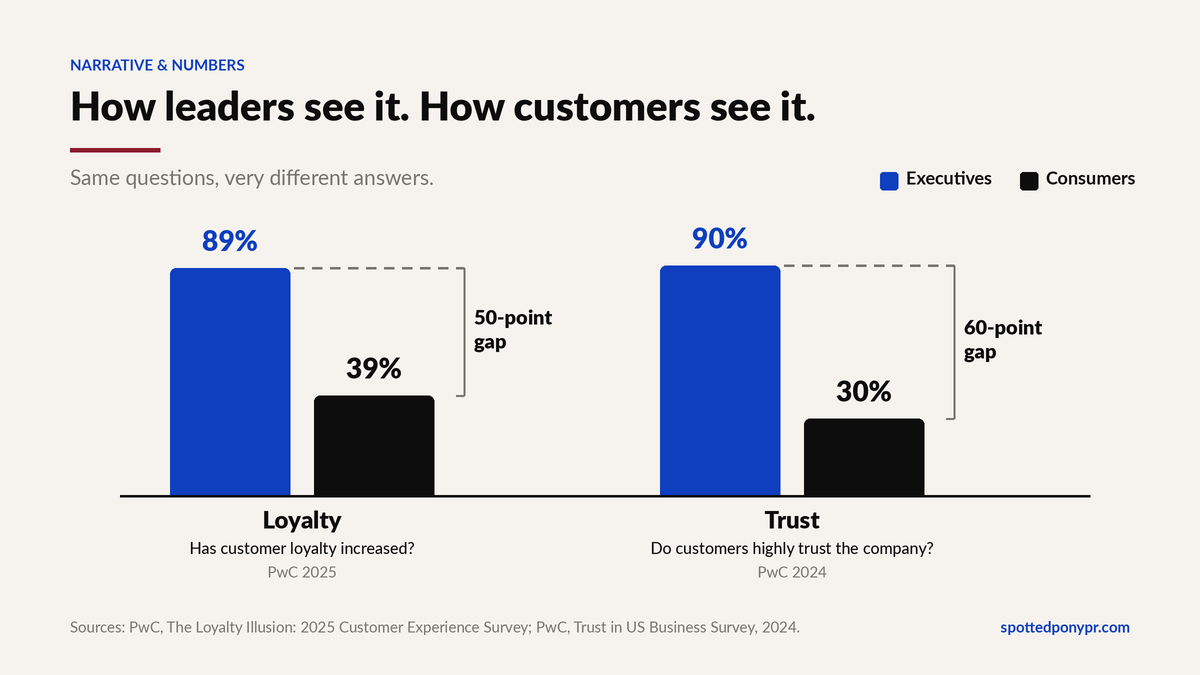
- Leaders see a stronger brand than their customers do. PwC found gaps of 50 to 60 points between how executives and consumers rate customer loyalty and trust.
- Brand Engine Optimization (BEO). Protect how your brand is interpreted before any algorithm reads it.
- Know what the world sees. Audit AI, review platforms, earned media and socials to set a baseline of your brand congruence, then revisit it monthly.
- Know what to do about it. More data isn't the answer. Find what's working, what isn't, and the revenue consequence of the gap.
- Know if it's working. Look for correlation between your goals and how the work moved, not proof of cause, and share the results with the people responsible for them.
Oh measurements, the sweet proof that what we do is worth the investment. I learned to be skeptical of data as a political science student. Not that it is false or unfounded, but that it can be written, read, and interpreted however is needed to get the desired results even when highly reviewed and regulated. As a communicator and founder, I am more interested in what the data means and, in some cases, the measurements are clearly for vanity rather than credibility.
So how are we supposed to measure whether our communications work is worth the time and budget in the Interpretation Era? AI has ushered us into a new time that requires new methods of thinking and measuring. It also makes those new methods possible.
You want to know if your work is effective? You have to start with knowing how the world sees you. And be honest about what you find so you can build clear and consistent strategies that will be more effective in helping you reach the goals that matter.
Know what the world sees
Your organization’s brand is one of your most valuable assets. It is how the world recognizes you, and not just by your logo. Think of your organization’s messaging that should tell the world exactly who you are and why they need you. Do you know it? Do your employees know it? Can your audience see themselves in it? Does AI repeat it? Does it set you apart from your competition?
PwC's 2025 Customer Experience Survey1 found 89% of executives said customer loyalty had increased in recent years. Only 39% of consumers agreed. A year earlier, PwC's 2024 Trust in US Business Survey2 found that 90% of executives believed their customers highly trusted their company, but only 30% of consumers said they did. That’s a spread of 50-60 points across the years for trust and loyalty, both strong indicators of how your brand and reputation are doing in the wild. No executive would allow that kind of gap to remain in sales so why is it okay for an organization’s brand and reputation? The harder truth is that AI is exposing those gaps.
To stay ahead of being incorrectly represented or made to look generic, the work has to be done far upstream. Brand engine optimization (BEO) has been treated as a downstream tactic to adjust your brand for the algorithms. It’s time that BEO be prioritized to protect how your brand is interpreted no matter who reads it, whether in search, answers, or AI, so that what the world sees is recognizably, defensibly yours.
If you haven’t already, now is the time for an honest audit of who the world believes you are and if it is the reputation you intended. Since AI is the topic of the hour, start with a search of your organization in Google Gemini, ChatGPT, and Perplexity then move to review platforms, earned media, and socials. Use the audit to establish a baseline of how your brand is being interpreted today across your AI and human audiences. Decide if what you find is the reputation you intended. This measurement is your brand congruence. Mark it and plan to revisit the same platforms once monthly.
And for the love of your brand, be honest. I shouldn’t have to say it, but these are different times and honesty is not what it used to be. PwC’s surveys are just one example. How can you expect to be effective if you ignore the evidence? How can your audience trust your organization if you remain tone-deaf to what is being said about your brand?
Know what to do about it
What did AI and your human audiences say about your organization during the audit? Did you show up exactly as you intended or was there outdated product or service information or worse, completely fabricated details?
The people and teams responsible for managing all of this already have full plates. And more data isn’t the answer. Your measurement tools are still relevant even if the meaning of the data has shifted. Citation ranking, share of voice, brand mentions, earned media are all still significant. They are the individual measurements for the overall picture of brand congruence. If you are showing up consistently across the communications continuum, you will be winning the brand and AI race while establishing the foundation needed for launching and scaling what comes next.
If your brand is not showing up consistently, start with figuring out what is working and what isn’t. Maybe you have a strong social presence, but your website hasn’t been updated since the last budget cycle or longer. You could also have a really strong Founder or CEO brand, but does that reputation extend to the organization and are they consistent?
You also need to decide if the goals that have been set in the past still matter. Then decide how they can be measured in today’s communications ecosystem. Can you determine a revenue consequence that can be correlated to the new goals and outcomes?
The thing about brand is it’s not a short game tactic. It is the reliable, steady, recognizable strength of your organization that endures even when campaigns end, top tier hits are forgotten, and awards have collected dust. It should not be left to interpretation nor left vulnerable to a trust deficit.
Know if it’s working
Proof. It’s a strong word for work that, generally speaking, cannot always show a direct causal relationship to the goals that were set. A correlation between the goals and how the work has moved can still be a strong indicator. This is one of the reasons why establishing a baseline for your measurements now is so important. Charting progress from one audit to the next will help you see what is working and what needs more attention.
Your communications today cannot be reported against last year’s communications in direct comparison unless you had already shifted your strategy for the age of AI. It’s not too late to start new measurements if you’re only now seeing the impact of the changing tides.
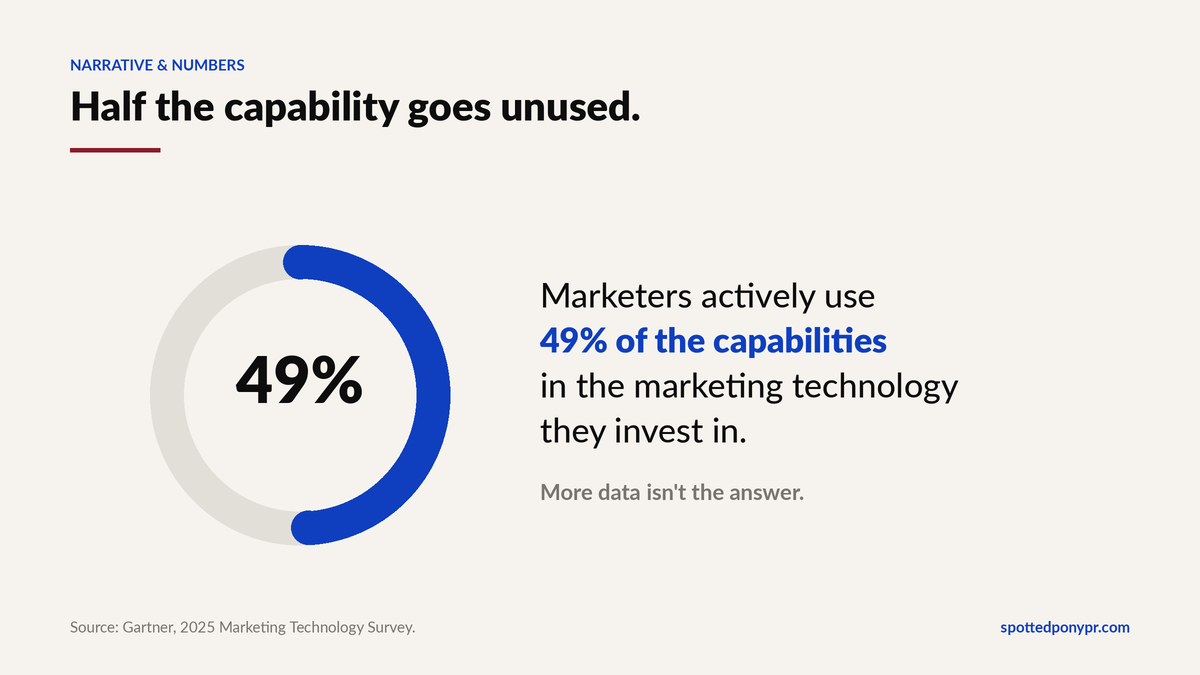
Keep in mind the measurements are only as good as their meaning. Don’t get me wrong, I love a good looking chart with bright colors, but data fatigue is real. According to Gartner’s 2025 Marketing Technology Survey3, marketers are only actively taking advantage of 49% of the tool capabilities that they invest in. It’s also common for there to be a dissemination issue with the data. One person or team gatekeeps the data, while multiple people or teams are responsible for the outcome. Data is meant to be shared. If it’s strong, why keep it to yourself? Good or bad, it can’t help the organization if the people who need to know it are kept in the dark.
Teams are stretched completing their goals and now learning new systems. Small business owners already have enough to do without having to spend their free time scouring the internet about their brand. Agencies are pivoting to make sure their clients have the tools they need while still delivering on the scope of work. It’s a lot.
It’s why I decided to create a new kind of brand measurement tool (yes, another tool, but unlike any you’ve tried). It is a complete feedback loop from diagnosis to plan to proof. The SPOTTED Brand Trust System application launches this year. I am looking for founding users to join a small demo cohort to test it. Interested? Send me a message to learn more.
Whatever you choose to measure or the strategies to adopt, remember to do what works for your organization. There are many different ways to approach communications and it can be overwhelming to keep up with it all.
Until next time.
Head up. Heels down.
Beth
Sources
- PwC, The Loyalty Illusion: 2025 Customer Experience Survey, 2025. Survey of about 5,500 US consumers and 400 executives, spring 2025. https://www.pwc.com/us/en/services/consulting/commercial-excellence/library/2025-customer-experience-survey.html
- PwC, Trust in US Business Survey, 2024. Survey of 548 executives and 2,515 consumers, fielded January 2024. https://www.pwc.com/us/en/library/trust-in-business-survey.html
- Gartner, 2025 Marketing Technology Survey, 2025. https://www.gartner.com/en/marketing/topics/marketing-technology